When Did a 6-Hour Course Make Someone a Skin Specialist?
This blog post is going to be a bit different.
As many of you know, we are actively looking for someone to join our team as a facialist.
We have come across many applicants, and more and more are applying with nearly any qualification.
What Training Used To Look Like
When Tasha and I started to work as therapists, the minimum level you had to complete was a Level 2 Beauty Therapy qualification. This was before you could touch a single client.
I remember when I was at school studying towards my qualification. We practised on each other as students. Every single day, we had to do facial massage, learn how to apply products and how to use product brushes on each other.
As a warm-up, we had to practise the massage movements with our fingers on our knees for about 15 minutes.
Then there was skin knowledge, facial anatomy, products and ingredients. We even learnt how to make products by mixing the raw ingredients together. How to make a basic moisturiser from scratch.
This went on for 3 years, from 8–4pm, Monday to Friday…
It was hard work.
But when I finished, I knew what I was doing.
I knew how to treat small lines and wrinkles, I knew how to wax properly and, yes, I learnt how to shape an eyebrow.
But those days were different.
We had time to study. We didn't want to rush home to watch only one more post on TikTok.
No, I went home and asked my mum or sister if I could try the new technique I had just learnt on them.
And, of course, my mum looked like a clown with her brand-new eyebrow shape and tint, and my dad had a patch on his ear after a partly successful ear wax.
But it did not happen to a paying client.
What's Happening Now
These days, everything is so fast.
Students take shortcuts with qualifications that last only 6 hours, and they call themselves a skin specialist.
After a 6-hour online course…
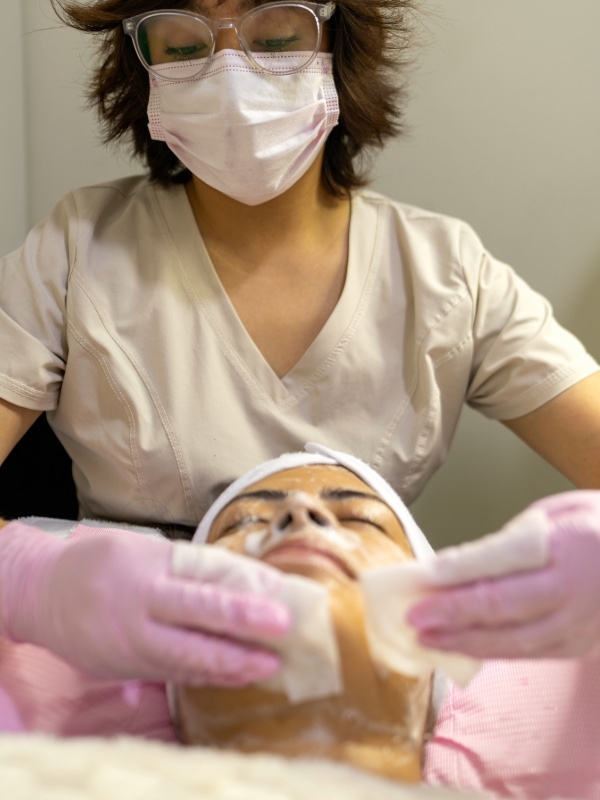
They show me their certificates, and I always ask them to do a 30-minute mini facial on me.
I want to see what they actually know, not just what is written on a piece of paper.
I want to see how they work. How they touch the skin. How they communicate. Whether they understand what they are doing or whether they are simply following the steps they have learnt.
What They'd Actually Need To Learn
And then I tell them what they'd actually need to learn before they touch a client in our salon.
You have to learn about the skin, the layers, the cells, skin conditions, products and ingredients. You need to understand why you do this and this, why you choose one product over another and why one treatment might be suitable for one person but completely wrong for another.
You also need to understand how important customer care, communication and attention are.
You need to know when something isn't suitable.
And, just as importantly, when you shouldn't treat someone at all.
And once you have learnt everything about the skin and products, and you have mastered how to be a reasonably good therapist, then you can ask people for their money.
You can't just expect a client to walk into your salon, cleanse, tone, moisturise and charge £100 for it with your 6-hour online qualification.
People work hard for their money.
Well, most people do.
Why It Matters
The worst thing is that most of them don't even understand what is wrong with their hard-earned 6-hour qualification.
"How come you don't accept it?"
"What is wrong with you?"
"Why would you want to teach me anything?"
Because there is a huge difference between learning the steps of a facial and actually understanding skin.
You cannot properly treat something you don't understand.
Protecting Our Profession
This is about protecting our profession.
It is about standing up against short, fast-track courses that give someone a certificate after a few hours and allow them to call themselves a skin specialist.
This needs to stop.
We have spent years learning our profession.
We have practised, made mistakes on each other, studied the theory and built our knowledge through experience.
That should mean something.
It is not fair to put someone through years of training to become a qualified therapist and then allow a six-hour course to be treated as if it is the same thing.
And this isn't just about therapists.
It is about the clients who trust us with their skin, their money and their expectations.
They deserve to know the difference between someone who has genuinely trained in skin and someone who has completed a fast-track course and been given a certificate.
Being able to perform the steps of a facial does not make you a skin specialist.
Understanding the skin does.
This is why we will continue to stand against these fast-track qualifications and push for higher standards within our profession.
Because if we don't protect the standards of our industry, who will?
Is There A Light In The Dark?
Luckily, there is a light in the dark.
Slowly, the industry is starting to realise that these short courses are creating a problem. People are being given certificates after a few hours of training and then presenting themselves as qualified professionals.
We are not saying that everyone needs to know everything before they start. Everyone has to start somewhere.
But there is a big difference between starting your career with proper training and doing a six-hour course and immediately calling yourself a skin specialist.
At Skinportant, we will continue to train our therapists properly.
We will teach them our treatments, our products, our techniques and, most importantly, how to understand the skin they are treating.
So we will keep looking.
And hopefully, we will find someone who can provide you with the same level of standards that Tasha and I do.
Because when someone puts their face in your hands, a certificate isn't enough.
You need to know what you are doing.