Most sun damage from a holiday isn't one cause — it's several small ones stacking up: sunscreen applied too thin, reapplication skipped once everyone's had a few drinks, the same handful of spots missed every time, actives left in the routine too long, chlorine and cabin air ignored entirely. Individually minor. Together, that's what shows up as damage in October. Here's how to actually get it right.
The 60-second version, if that's all you need:
- Ease off retinol/acids 1–2 weeks before travel if your skin isn't fully adjusted to them
- Use a full teaspoon of sunscreen on your face and neck, not a smear
- Reapply every 2 hours outdoors, immediately after swimming
- Wash your hands after squeezing citrus before you go back in the sun
- Cool compresses (not ice) for sunburn, no petroleum jelly
- Keep SPF 50+ going for weeks after you're home if you got any new pigmentation
Now the detail.
How Far in Advance Should You Start Preparing?
Skin needs time to heal before it's hit with concentrated UV, heat, or chlorine. Book chemical peels 1–2 weeks out, microneedling 2–4 weeks out, laser or IPL work 4–6 weeks out. Injectables need 2–3 weeks to settle. The mistake we see constantly: booking a treatment days before a flight. Freshly treated skin is more reactive to sun, not less.
Should You Pause Retinol Before a Sun Holiday?
Retinol doesn't cause photosensitivity — that's a myth. The real issue is irritation. Skin that's new to a retinoid, already compromised, or recently stepped up in strength handles sun badly. Already acclimatised? Keep it to nights, wash it off before sun exposure, and apply SPF properly. Not fully adjusted, or using AHAs/BHAs too? Stop 1–2 weeks before you travel.
Build an Antioxidant Defence Early
A vitamin C serum under your morning sunscreen neutralises free radical damage before it accumulates — start weeks before the trip, not the morning you leave. It won't replace sunscreen, but it's a genuinely useful layer on top of one.
Pick the Right SPF — Our Recommendation
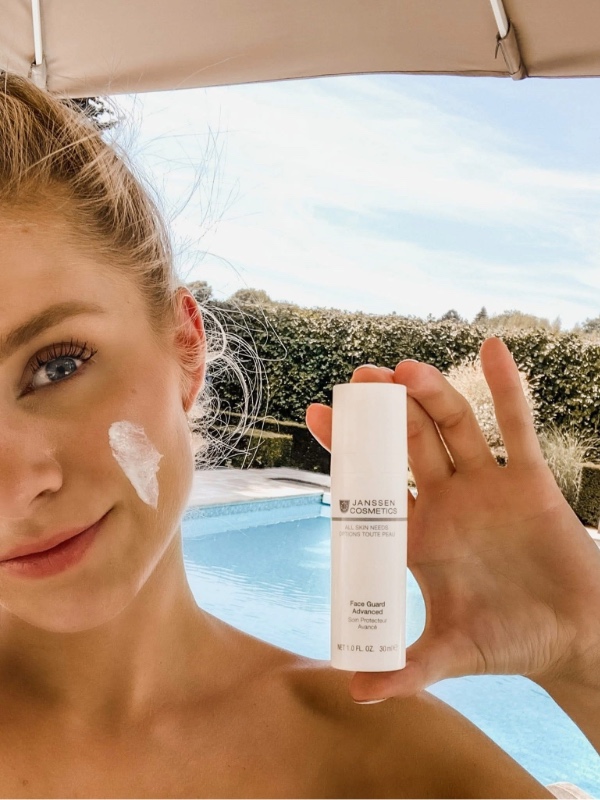
Our go-to for clients, holiday or not, is Janssen Cosmetics Face Guard Advanced (SPF 30). It combines mineral and chemical filters for broad-spectrum UVA/UVB coverage, with Ectoine and an antioxidant enzyme adding infrared and environmental protection on top — one formula that covers daily wear, travel, and everything in between.
The Number Most People Get Wrong Isn't the SPF — It's the Amount
A full body needs about a shot glass of sunscreen. Your face and neck need a quarter to half a teaspoon. Most people apply 20–50% of that. Half the dose means far less than half the protection — a fully applied SPF 30 will beat an under-applied SPF 50 every time. Give it 15–30 minutes to bind before you go outside; putting it on as you walk out the door leaves you exposed.
Reapply on a Clock, Not a Feeling
Every 2 hours outdoors. Immediately after swimming or heavy sweating — even "water-resistant" only holds for 40–80 minutes, and nothing is actually waterproof. This holds even with photostable modern filters: they resist breaking down in UV, but sweat, water, and friction from towels or clothing still physically remove product regardless of how stable the filter chemistry is. SPF 30 blocks about 96.7% of UVB, SPF 50 about 98% — a one-point difference. Reapplying matters more than the number on the bottle. Cloud doesn't save you either: up to 80% of UV gets through, and UVA cuts straight through car and window glass.
One nuance worth knowing: this two-hour rule is for active outdoor exposure — beach, poolside, hiking. For an ordinary indoor-mostly day (office, commuting), one thorough morning application is generally enough, since you're not sweating, swimming, or rubbing it off throughout the day.
The Spots You're Skipping
Ears, eyelids, lips, the scalp parting, backs of the knees, tops of the feet. Eyelid skin is thin and disproportionately prone to skin cancer — sunglasses first, a mineral stick second. Lips have almost no melanin, so an SPF lip balm reapplied after eating or drinking isn't optional.
Chlorine, Salt Water, and Cabin Air Are Each Their Own Problem
Chlorine strips your skin's natural oil. Salt water dehydrates as it evaporates. Wet your skin before getting in the pool, rinse off straight after, follow with a fragrance-free cleanser and a real moisturiser. On flights, cabin humidity can drop below 20% — hydrate before boarding, carry a moisturiser with both a humectant and an emollient, and skip the sheet mask, since dry cabin air just pulls the moisture straight back out of it.
The "Margarita Burn" Nobody Warns You About
Lime juice on your skin plus sun exposure causes a real chemical burn — redness, blistering, weeks of dark pigmentation. It's shockingly common on beach holidays with cocktails involved. Wash your hands after squeezing citrus, before you're back in the sun.
Is Self-Tanner the Safer Shortcut?
Yes, essentially. DHA-based self-tanner carries almost none of the cancer risk of a real UV tan. It gives you zero sun protection though, so sunscreen underneath still isn't optional. Exfoliate first, apply thin and even, wash your hands immediately after to avoid stained palms.
If You Get Burnt: The First 24 Hours
Cool compresses, ten minutes at a time — not a direct ice pack, which can add frostnip on top of the burn. An anti-inflammatory for pain. Aloe on damp skin. Skip petroleum jelly, benzocaine, lidocaine, alcohol — all trap heat or trigger reactions. Don't pop blisters. Drink more water than usual.
Rebuilding the Barrier Once You're Home
Give it 1–2 weeks before actives go back in. Gentle cleanser, lukewarm water, hyaluronic acid or aloe under a ceramide-rich moisturiser. Most people see real improvement in 5–10 days; serious sun or wind damage can take 2–4 weeks.
Pigmentation Doesn't Fade With the Tan
New dark spots and melasma flare-ups run on their own timeline, and they keep getting worse with any further sun exposure. Keep SPF 50+ going for weeks after you're back. If it isn't improving after a few weeks of consistent SPF, that's when to come in rather than wait.
If you're left with stubborn sun damage or pigmentation once summer is over, it doesn't have to be permanent — our hyperpigmentation treatments are designed to target exactly this, and autumn is the ideal time to start, once direct sun exposure has eased off. Come in and we'll assess it properly rather than you waiting to see if it fades on its own.
Post-Holiday Breakouts
Usually gone within 1–2 weeks on a gentle, non-comedogenic routine once you're home. Painful, cystic, or breakouts that won't quit are worth an actual appointment rather than more guessing.
A Few More Questions We Get Asked
Can I use last year's holiday sunscreen? Only if it hasn't expired and smells/looks the same as when you bought it. Heat degrades UV filters faster than the printed date suggests.
Does a base tan protect me? A base tan is worth roughly SPF 2–4. Negligible. Not a reason to skip sunscreen.
My skin breaks out the first few days of a trip, then settles — normal? Usually, yes, it's adjusting to new water, climate, and products. If it's still going after a week, suspect the sunscreen or whatever new product you packed.
I'm already burnt on day two of a two-week trip — is it too late? No. Treat it, cover up and stay shaded for 48 hours, then get back to rigorous SPF as soon as your skin can take it. The real damage comes from a second burn stacked on the first.
Prepared before, protected during, repaired after. No expensive products required — just the right step at the right time, and a formula suited to your skin. If you're planning a trip, or you've come home with pigmentation or damage worth a proper look, book a consultation.